
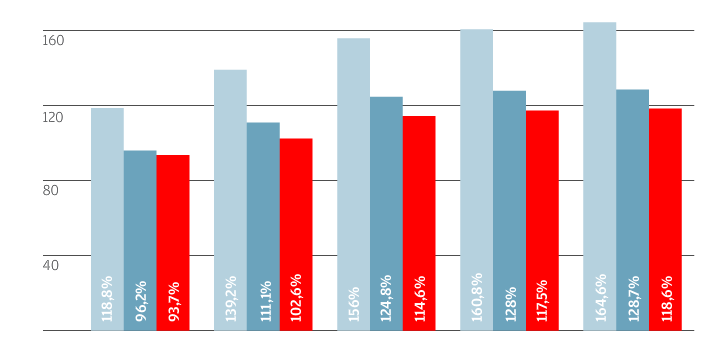
Infographics: Families and businesses lower debt for the second consecutive year
- admin
- March 3, 2015
Public debt increased again in 2014, albeit at a slower rate than in previous years, a trend that contrasts with the strong deleveraging of the private sector. The indebtedness of households and firms fell almost 20 percentage points last year. See infographics with the evolution of the debt of Portugal since 2011.
The data that the Bank of Portugal published on Monday in the Statistical Bulletin confirm the upward trend of the Portuguese government debt and an opposite trend in the debt of companies and families.
Government debt as measured by the Brussels criteria ranked 224.5 billion at the end of 2014, equivalent to 128.7% of GDP. A weight compared with the 128% of GDP in 2013 to 124.8% in 2012.
The debt amount considered by Brussels does not take into account deposits of public institutions belonging to the central government. If this is discounted, then the weight of public debt fell about 10 points of GDP (close to EUR 17 billion) to 118.6% of GDP. Have total public debt rose to 164.6% of GDP in 2014.
In the private sector the trend was down debt for the second consecutive year, either in industry or in families. With the growth of the economy and the reduction of debt levels, the weight of the indebtedness of the non-financial private sector fell from 247% of GDP in 2013 to 227.6% of GDP last year.
A decline that is mainly due to reduction of corporate debt (increased from 155.8% of GDP in 2013 to 142% of GDP last year), but also households (the weight of the debt has declined from 91.3% of GDP to 85.7% of GDP).
Comparing 2014 with 2012, the company lowered the debt by 19.6 percentage points and 7.7 percentage points in families.


 Português
 English